

“We get plenty of applications, but they rarely turn into interviews.”
“Candidates reply to our scout messages, but then communication just stops partway through.”
Have you ever faced challenges like these?
Candidates who are job hunting are, in most cases, going through the selection process with several companies at the same time.
As a result, a company’s initial response has a major impact on both interview acceptance rates and overall hiring success.
In this article, we’ll share two golden rules for increasing the number of interviews you conduct—insights drawn from CareerCross’s interview-offer data.
Rule 1. Offer an interview within 5 days of the application
The first key factor is the speed with which you go from receiving an application to offering an interview.
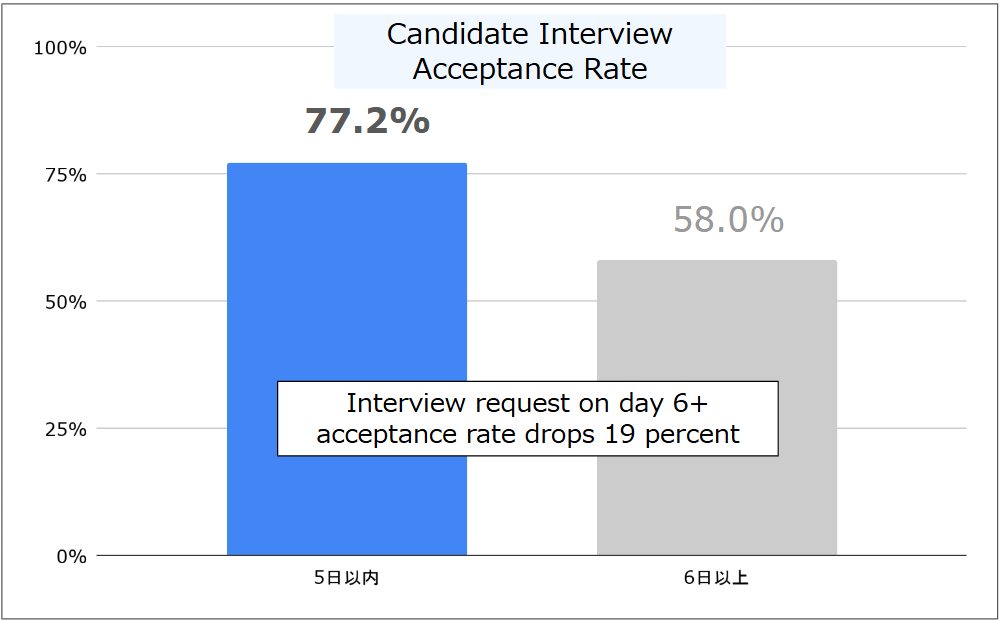
Looking at the data, when we compare:
・Offering an interview within 5 days of the application
・Offering an interview 6 or more days after the application
We found a difference of roughly 19 percentage points (more than 1.3x) in the interview acceptance rate.
Digging deeper, we found that within the 5-day window, there was no significant difference between offering on “the next day” versus “the fifth day.”
In other words, what matters is not “as fast as possible,” but acting within 5 days.
Why does “5 days” become the dividing line?
By the time 5 days have passed since the application, a candidate’s situation has often changed considerably. For example:
・The enthusiasm they felt when applying fades
・Document screening and interviews with other companies move forward
Within 5 days of applying, a candidate is still in the stage of comparing and evaluating multiple companies.
As a result, messages from any company tend to be considered on equal footing.
Practical tips
We recommend establishing these as internal rules:
・Complete document screening within 3 business days
・Offer an interview within 5 days of the application
[Example message]
“Thank you for your application. We would very much like to meet you and are currently moving forward with our review. We will contact you with proposed interview dates by [Month/Day], so we appreciate your patience in the meantime.”
Sending an advance note like this reassures the candidate and reduces the risk of losing them to other companies.
Rule 2. Present specific dates and times when offering an interview
When coordinating interview schedules, companies generally use one of two approaches:
Pattern A: The company proposes specific dates and times
Example: “Would any of the following work for you? Tue, [Month/Day] from 2:00 PM / Wed, [Month/Day] from 6:00 PM / Fri, [Month/Day] from 6:00 PM”
Pattern B: The company asks the candidate to propose dates and times
Example: “Please let us know a few dates and times that are convenient for you.”
At first glance, Pattern B might seem more considerate toward the candidate.
In reality, however, the data shows that Pattern A produces an interview acceptance rate roughly 16 percentage points higher (more than 1.2x).
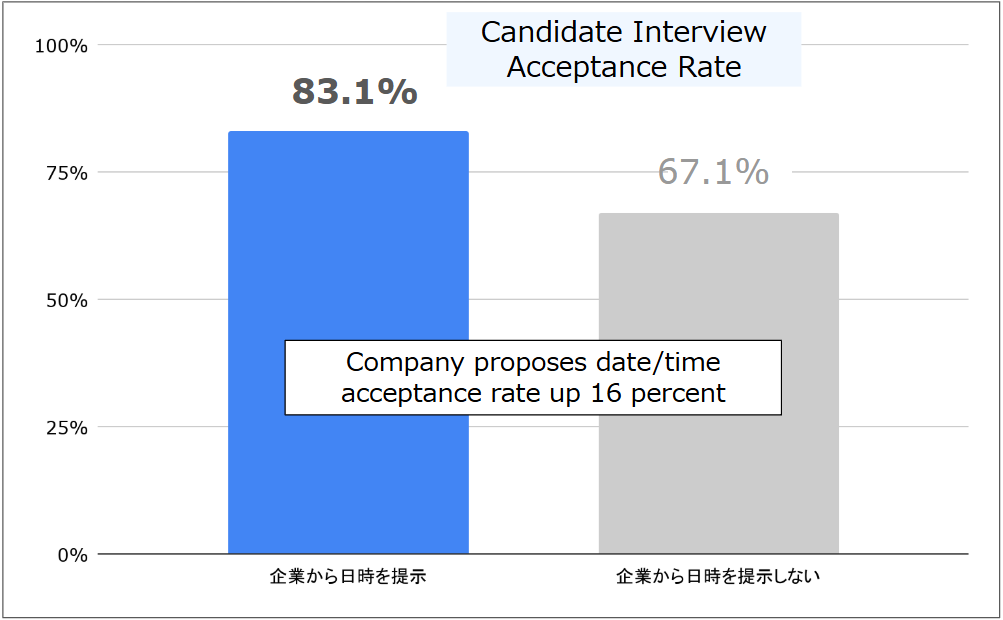
Why does proposing specific dates work so well?
Candidates are juggling exchanges with multiple companies at once. Within that, tasks like:
- Checking their calendar
- Finding open time slots
- Compiling and replying with candidate dates
are surprisingly burdensome.
As a result, it’s not uncommon to see a chain of:
“I’ll reply later”
→ “forgets to reply”
→ “and the selection process with another company moves ahead in the meantime.”
On the other hand, when the company has already proposed candidate dates and times, the candidate only needs to judge “yes” or “no.”
This lowers the barrier to replying and makes it easier to smoothly move toward an interview.
Practical tips
When offering an interview, we recommend presenting about three candidate dates/times.
With only one option, you’ll need to re-coordinate if it doesn’t work.
Conversely, too many options make it hard to choose.
Balancing “ease of choosing” with “ease of scheduling,” around three options is optimal.
Summary | Two actions you can start practicing today to lock in interviews
What you can do to raise your interview acceptance rate isn’t about introducing special systems or tools—it’s about accumulating small improvements in your initial response.
1. Always complete your interview offer within 5 days of the application
2. When offering an interview, have the company present about three specific candidate dates and times
Simply being thorough about these two points can be expected to improve the number of interviews conducted—and ultimately, your hiring outcomes.
The more a company feels it “can’t find good people,” the more its attention tends to turn toward increasing new applications or revising job postings. But why not start by reviewing your initial response to the candidates right in front of you?